 insightstream.dev
Agentic AI is Not Automation — It’s Decision Infrastructure
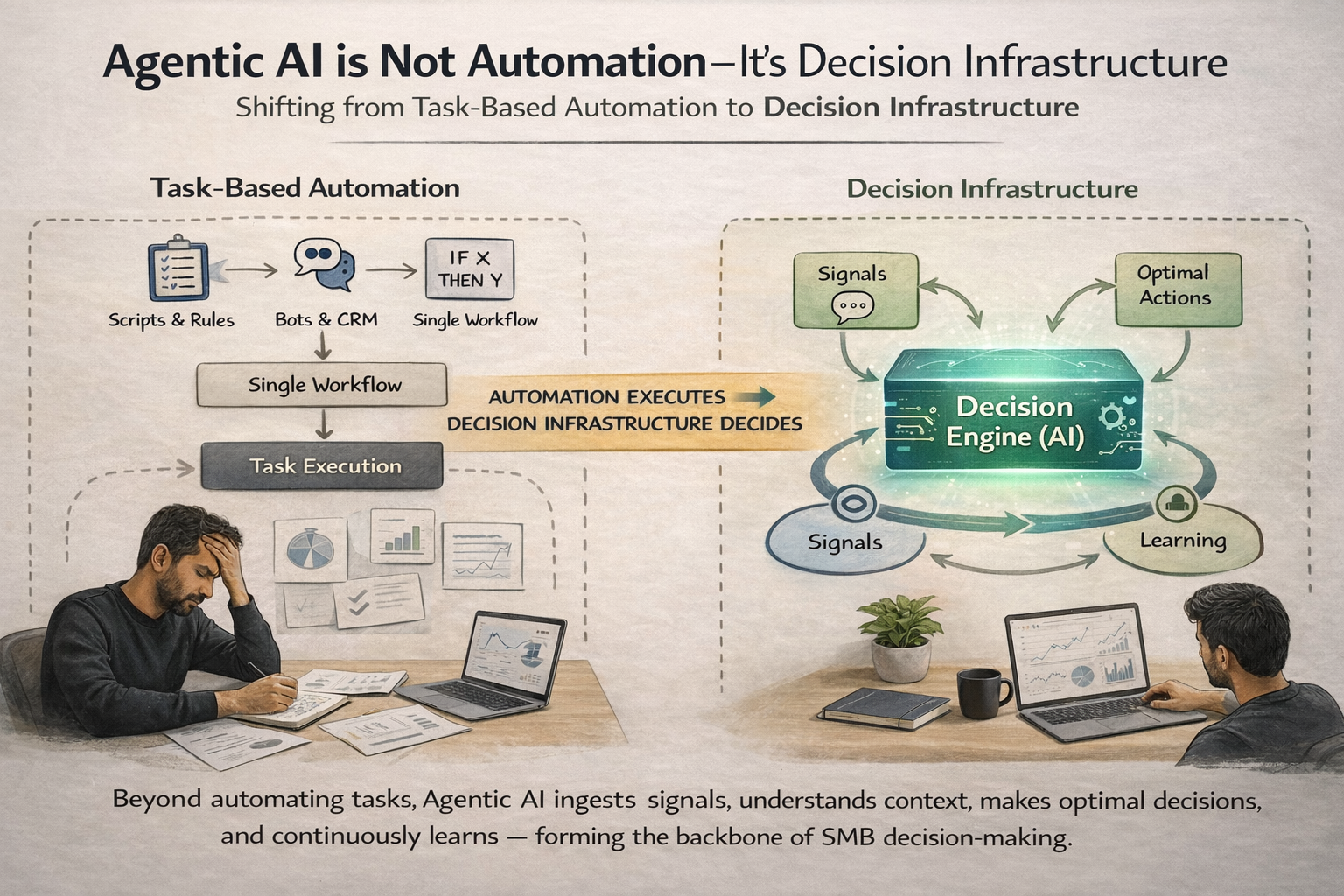
1. Hook — Problem Framing
You’ve set up your automated “Welcome” email and a chatbot that triggers when a lead clicks a link. On paper, you are “using AI.” But in reality, your inbox is still full of edge cases that require your personal intervention—the “pricing for a 50-person team” or the “integration with a legacy CRM” questions. You haven’t actually offloaded the work; you’ve just automated the noise.
2. Evidence — What the Data Says
- According to McKinsey, the “AI high performers” are distinguished by their ability to move from isolated pilots to embedding AI into core business workflows that influence how decisions are made.
- Based on Gartner, 60% of brands will move past predefined workflows to use agentic AI for one-to-one customer interactions by 2028.
- Recent Market Signal: While 88% of firms report using AI, only 29% of SMBs have successfully scaled it. The difference lies in moving from “task-completion” to “decision-making.”
3. Problem Breakdown — Why This Happens
- The “Pricing Inquiry” Bottleneck: Traditional automation sends a generic PDF regardless of the lead’s size. A human still has to “decide” if that lead deserves a custom quote.
- The “Support vs. Sales” Loop: Simple bots just route tickets. They can’t “decide” to escalate a frustrated high-value client to a founder while drafting a recovery response.
- Rules Over Reason: Automation follows a script; if the customer deviates by 5%, the system breaks.
- Inaccuracy Without Oversight: 33% of firms report negative consequences from AI inaccuracy. Automation repeats errors; decision systems use feedback to fix them.
4. Why Existing Solutions Fail
- Chatbots are reactive, not intelligent: They answer “What is X?” but cannot answer “Given my situation, what should I do next?”
- CRMs store data but don’t act on it: They are passive record-keepers, requiring a human to log in and “decide” which leads are warm.
- Tools are siloed: Because your tools don’t share context, your “automated” follow-up often ignores the conversation the customer just had with your support bot.
5. The Shift — What’s Changing with Gen AI
Agentic AI introduces Decision Infrastructure. Generative AI enables:
- Contextual Reasoning: The system evaluates multiple variables (company size, intent, sentiment) before choosing an action.
- Dynamic Adaptability: Agents can pivot their strategy mid-conversation based on new information.
- Closed-Loop Execution: Instead of waiting for a human, the system decides, executes, and then checks the result against the business goal.
6. System Design View — What Actually Works
For an SMB, you aren’t building a bot; you are building a Decision Engine.
- Input Signals: Real-time behavior, sentiment, and intent.
- Context Layer: Your technical PRDs, pricing sheets, and historical customer data.
- Decision Engine (The Agent): The reasoning layer that determines “What should happen next?”.
- Action Layer: Updates the CRM, books the meeting, or triggers a personalized quote.
- Feedback Loop: Automatically flags inaccuracies to improve the next decision.
7. What Actually Works — Practical Principles
- Stop Designing Workflows; Start Designing Decision Loops: Focus on the outcome (e.g., “Qualified Demo”) rather than the step-by-step script.
- Optimize Outcomes, Not Tasks: Don’t just send emails faster; convert leads more intelligently.
- Unify Your Signals: Your AI needs to know what’s in your financial documents and your chat history to make an informed decision.
- Implement Human-in-the-loop for Edge Cases: Design triggers where the agent “decides” it needs your specific founder-level expertise.
8. Strategic Insight — Founder-Level Take
The real opportunity is not replacing human effort—it is replacing decision bottlenecks. Growth is constrained by how fast you can decide, not how fast you can type. Agentic AI is the infrastructure that allows a solo founder to make 1,000 “perfect” decisions a day.
9. Subtle Product Layer (SigSense Positioning)
This is the direction we’re exploring — where conversations stop being static data and become structured signals that drive autonomous growth systems.
10. Closing
SMBs don’t need more tools. They need systems that can think, decide, and improve over time. The winners of the AI era won’t be the ones who automate the most; they will be the ones who decide the best.
Reference Links
Source: McKinsey & Company Insight: High performers redesign workflows to embed AI into core decision-making.
Link: https://www.mckinsey.com/capabilities/quantumblack/our-insights/the-state-of-aiSource: Gartner Insight: 60% of brands will move to agentic AI for one-to-one scaling by 2028.
Link: https://www.gartner.com/en/newsroom/press-releases/2026-01-15-gartner-predicts-60-percent-of-brands-will-use-agentic-ai-to-deliver-streamlined-one-to-one-interactions-by-2028Source: Adweek Insight: AI is transitioning into an orchestration layer for the entire marketing stack.
Link: https://www.adweek.com/brand-marketing/10-ai-marketing-trends-for-2026-agentic-ai-and-search-shifts/