 insightstream.dev
From Funnels to Feedback Loops: Rethinking Growth in the AI Era
1. Hook — Problem Framing
Think about your current sales funnel.
A lead signs up, receives an automated “Day 1” email, then a “Day 3” follow-up.
But what if that lead visited your pricing page four times between those emails?
What if they asked a technical question on your chat widget that your email sequence completely ignored?
In a traditional funnel, that lead is just a “stagnant” record.
You are pushing them through a line — rather than responding to their behavior in real time.
2. Evidence — What the Data Says
- According to Gartner, brands are moving toward systems that enable one-to-one interactions at scale, adapting dynamically to user behavior rather than relying on fixed journeys.
- McKinsey highlights that AI “high performers” are embedding continuous adaptation into core workflows, building systems that learn from every interaction.
This signals a clear shift:
Growth is moving from predefined execution to continuous, real-time decision-making.
3. Problem Breakdown — Why Funnels Break for SMBs
Linearity vs. Reality
Users don’t move step-by-step. They jump across stages based on intent.The “Leaky Bucket” Problem
When a lead drops off, there is no system to re-engage based on new signals.Static Messaging
Every user in a stage gets the same experience, regardless of context.Delayed Learning
Insights come after campaigns — not during interactions.No Real-Time Adaptation
Funnels cannot respond to behavior as it happens.
Funnels simplify growth.
But they also distort it.
4. Why Existing Solutions Fail
Most tools today are built to optimize funnels — not replace them.
- Marketing automation executes predefined workflows
- Analytics tools act as post-mortems
- Chat systems handle isolated interactions
These systems answer:
“What should happen next based on a rule?”
But they cannot answer:
“What should happen next based on this situation?”
That is a decision problem.
5. The Shift — What’s Changing with Gen AI
Agentic systems do not just improve funnels — they make them irrelevant.
They introduce a new model:
Growth as a continuous feedback loop
Instead of pushing users forward, systems can now:
- Observe behavior in real time
- Interpret intent dynamically
- Decide on next-best actions
- Respond immediately
- Learn from outcomes continuously
6. System Design View — What Actually Works
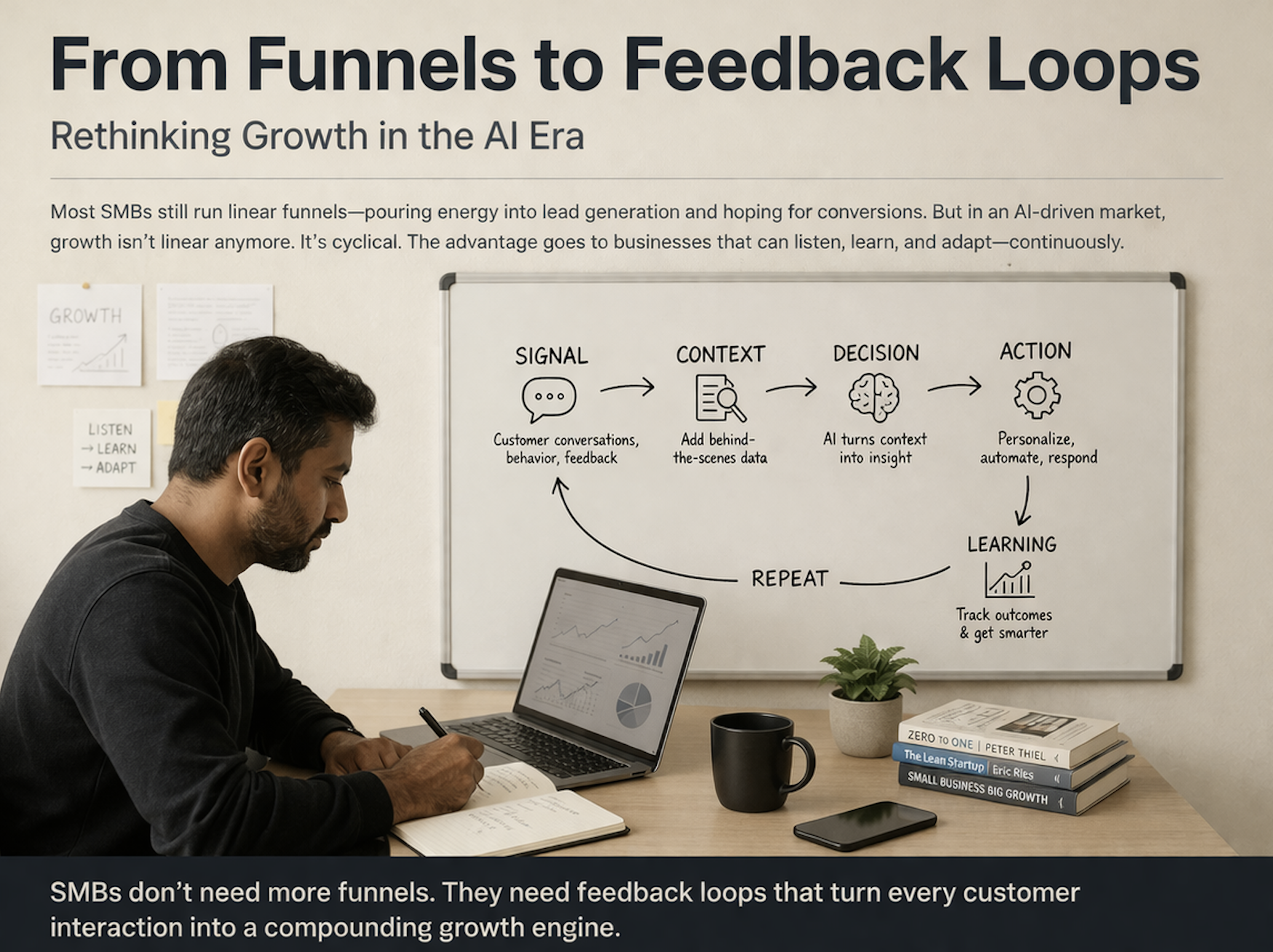
A modern growth system operates as a loop:
| |
Signal
Every interaction — clicks, queries, conversations — becomes input
Context
User history, business knowledge, and intent are combined
Decision
The system determines what should happen next
Action
Responses, routing, personalization, and engagement
Learning
Outcomes are fed back into the system to improve future decisions
This is not a funnel.
It is a continuously adapting system.
7. Practical Principles for the AI Era
- Stop designing journeys — design interaction systems
- Stop optimizing stages — optimize decisions
- Measure signal quality, not just drop-offs
- Respond to intent, not predefined steps
- Unify data across all touchpoints
The goal is not to move users forward.
It is to respond intelligently in real time.
8. Strategic Insight — Founder-Level Take
The real limitation of funnels is not inefficiency.
It is rigidity.
They assume:
- Intent is stable
- Behavior is predictable
- Progression is linear
None of these assumptions hold anymore.
Feedback loops solve this by enabling:
continuous decision-making based on real-time signals
The SMB that wins is not the one with the best funnel.
It is the one with the fastest, most intelligent loop.
9. Category Insight — The Emerging Pattern
We are moving toward systems where interactions are not just events — they are signals.
These signals, when structured correctly, enable systems that can:
- Interpret intent
- Make decisions
- Act in real time
- Improve continuously
The emerging pattern is clear:
Growth is no longer driven by campaigns or funnels — but by systems that can interpret, decide, and adapt dynamically.
10. Closing
Funnels were designed for a slower world.
Today:
- Intent changes in seconds
- Decisions happen in real time
- Opportunities are created and lost instantly
The future of growth will not be defined by better funnels.
It will be defined by systems that can:
Understand context Make decisions Act in real time Learn continuously
Observe → Decide → Act → Learn → Repeat
That is the new growth loop.
Reference Links
Source: Gartner Insight: Agentic AI enables one-to-one interactions at scale Link: https://www.gartner.com/en/newsroom/press-releases/2026-01-15-gartner-predicts-60-percent-of-brands-will-use-agentic-ai-to-deliver-streamlined-one-to-one-interactions-by-2028
Source: McKinsey & Company Insight: AI high performers embed continuous adaptation into workflows Link: https://www.mckinsey.com/capabilities/quantumblack/our-insights/the-state-of-ai